Talega Window Cleaning Guide 2026
Quick Answer: What makes Talega window cleaning different from coastal San Clemente?
Talega sits inland in northeastern San Clemente, shielded from direct ocean spray but exposed to three different glass-contamination sources: (1) hard water from irrigation systems fed by Colorado River water at 500–700 ppm TDS, (2) canyon dust from the Ortega Highway corridor during Santa Ana season, and (3) HOA exterior maintenance requirements from the Talega master association. Talega homes typically need professional window cleaning every 3–4 months, with a mandatory post-Santa-Ana clean from October through March.
Most window cleaning articles about San Clemente focus on ocean-facing homes. Talega’s challenges are almost the opposite — and they are frequently misunderstood by cleaners who do not know the neighbourhood.
Talega’s Specific Geography and What It Means for Your Windows
Talega was developed in the early 2000s as a master-planned community in the hills of northeastern San Clemente, roughly 3–4 miles from the coast. The neighbourhood sits in a basin formed by San Clemente Canyon, with the Ortega Highway corridor to the east and the Santa Margarita Mountains beyond. This geography creates three specific glass-contamination patterns that are unique to Talega.
The Hard Water Problem: Colorado River Minerals in Talega’s Irrigation
San Clemente’s municipal water supply — including the recycled water used for Talega landscape irrigation — comes from the Colorado River Aqueduct. Colorado River water arrives at approximately 500–700 ppm Total Dissolved Solids, primarily calcium carbonate and magnesium sulfate. When Talega’s irrigation system runs, sprinkler overspray deposits this mineral-loaded water on first-floor windows, ground-level glass, and lower storey window sills.
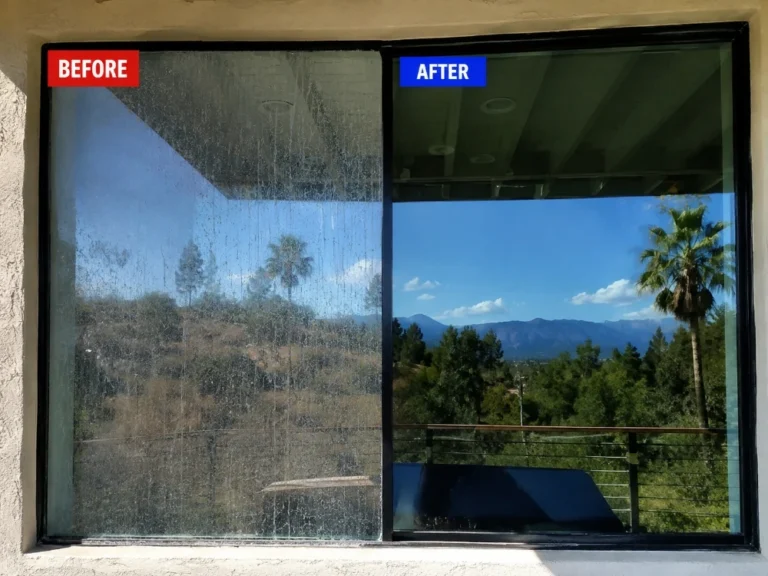
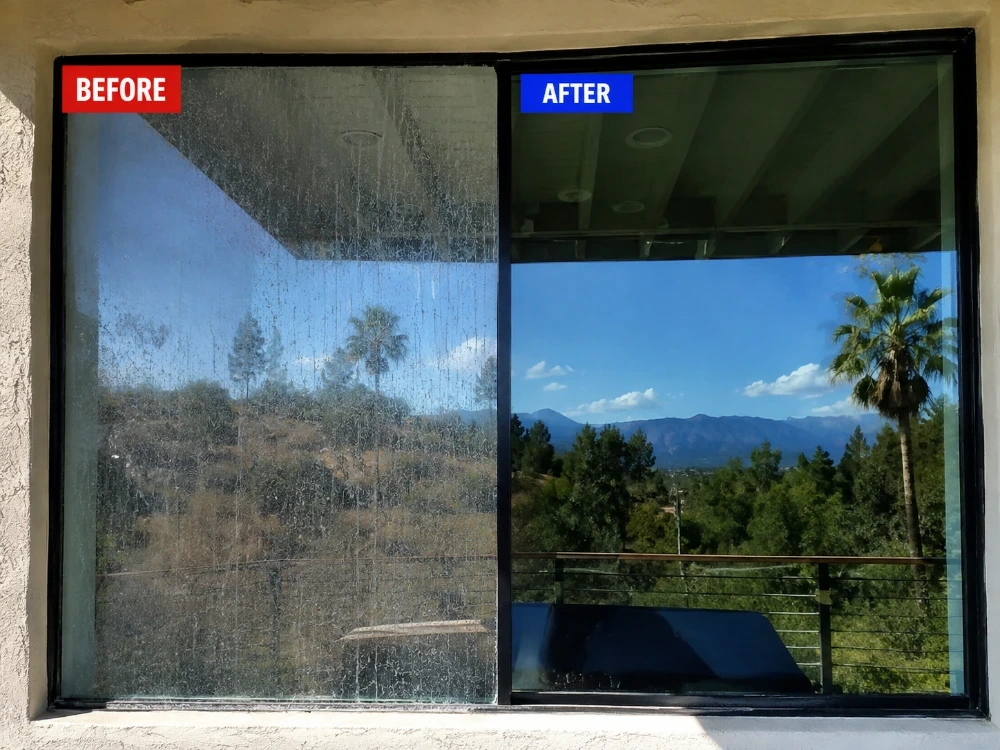
The mechanism is simple and relentless: a sprinkler head clips a ground-floor pane, the mineral water sheets down the glass, and San Clemente’s sun evaporates it within minutes. The calcium stays. Over weeks and months, those calcium deposits build up in layers — what we call a “bonded carbonate film.” Standard window cleaning removes surface dirt but does not touch established carbonate deposits. These require a professional acid treatment (oxalic or citric acid) at the correct pH and dwell time.
Why do Talega windows get hard water spots when they are far from the ocean?
Hard water spots in Talega come from irrigation overspray, not ocean salt. Talega’s landscape irrigation uses Colorado River water at approximately 500–700 ppm dissolved minerals. Every sprinkler cycle that clips a window leaves calcium carbonate behind when it evaporates. Over weeks, this builds into a white mineral film that standard cleaning cannot remove. Professional acid treatment dissolves the calcium bonds without scratching the glass.
The Canyon Dust Problem: Ortega Corridor and Santa Ana Season
Talega’s eastern border faces the Ortega Highway corridor — the primary Santa Ana wind funnel for southern Orange County. During Santa Ana events from October through March, gusts of 50–70 mph push desert dust, dried chaparral pollen, and wildfire ash directly into Talega from the canyon. Unlike coastal salt film, this desert material is alkaline — and when coastal moisture returns after a wind event, it reacts with the silica in your glass over 2–4 weeks.
The practical schedule for Talega homeowners: clean within 2 weeks of any major Santa Ana event, not “when it looks dirty.” By the time etching damage is visible under normal lighting, it is already permanent.
The HOA Compliance Problem
Talega’s master association has exterior maintenance standards for all homes within the community. These CC&Rs address the appearance of glass, screens, and exterior surfaces. The HOA performs periodic inspections and issues formal notices for homes that fail appearance standards — notices that carry fines until corrected. We have assisted multiple Talega homeowners who received HOA notices for hazy or mineral-stained windows, including a case where a faulty irrigation timer had been directing water onto east-facing windows for approximately 24 months, building 2mm-thick calcium deposits across 7 window panels.
| Talega Window Issue | Source | Treatment | Prevention |
|---|---|---|---|
| White mineral spots (ground floor) | Irrigation overspray | Acid treatment + clean | Adjust sprinkler heads |
| Grey-brown film (all elevations) | Santa Ana canyon dust | Standard professional clean | Post-event clean within 2 weeks |
| Hazy overall appearance | Calcium buildup over months | Deep acid treatment | Quarterly cleaning schedule |
| HOA compliance failure | Any of the above | Full clean + documentation | Recurring schedule + photos |
What a Talega Window Cleaning Costs in 2026
Standard professional window cleaning for Talega homes runs $200–$280 for single-story and $320–$500 for two-story homes, with screens and tracks included. Hard water acid treatment — required for most Talega homes that have not been cleaned in 6+ months — adds $80–$150 depending on severity and panel count. We assess the glass before quoting because deeply etched deposits (typically 2+ years untreated) may not be fully reversible without polishing — and we tell you that honestly before we start.
For Talega homes: we check sprinkler angles, assess hard water severity, and provide HOA-ready service documentation including before/after photos and a dated service certificate. Same-week scheduling available. Call (949) 387-4521.
📞 Schedule Talega CleaningSan Clemente Area Guides
Window cleaning needs vary significantly across San Clemente neighbourhoods. See our area-specific guides:
Talega Window Cleaning Prices 2026
Talega homes are predominantly two-story, with the large picture windows and extended glass frontages that characterise newer San Clemente construction from the 2000s and 2010s. This means Talega window cleaning typically falls in the higher end of San Clemente pricing ranges compared to the older single-story homes in coastal areas like T-Street or North Beach.
- Standard two-story Talega home (25–40 panes): $320–$450
- Large two-story with extended glass (40+ panes): $450–$600
- Calcium deposit acid treatment (first visit after irrigation exposure): +$80–$200
- Recurring quarterly plan: 10% off locked rate
Most Talega homeowners who have had their windows cleaned by a cheaper service first will need acid treatment on their first visit with us — the previous tap-water cleaning leaves a mineral film that requires descaling before genuine clarity can be achieved. We quote this transparently on arrival after assessing the glass condition, and it is charged separately from the base clean price. After the first visit, regular quarterly cleaning with 0 ppm water prevents any further mineral accumulation.
Ortega Canyon Dust and Talega Windows
Talega’s position at the inland end of San Clemente, close to the Ortega Highway interchange, makes it the neighbourhood most affected by Santa Ana wind events that carry alkaline dust and ash from the Ortega Canyon corridor. These events occur between October and March and can deposit visible surface contamination on glass within 24–48 hours of a wind event. The alkaline dust is particularly damaging because it bonds to existing salt film or mineral deposits on the glass surface, creating a composite residue that requires surfactant pre-soak before cleaning. We adjust our chemistry for Talega homes during and after Santa Ana season and recommend scheduling a clean within 2 weeks of any significant wind event.
Talega Window Cleaning — The Complete Neighbourhood Analysis
Talega is San Clemente’s largest planned community — approximately 5,000 homes across multiple villages on the hillsides above Avenida Pico. The neighbourhood was developed in phases from the early 2000s and the housing stock reflects that era: predominantly two-story homes with stucco construction, tile roofs, large picture windows on primary elevations, and extensive automated irrigation systems throughout. This combination creates a glass contamination profile that is distinct from coastal San Clemente and requires a different cleaning approach.
The primary Talega glass contamination source is not Pacific salt aerosol (though west-facing homes on the higher ridgelines do receive moderate salt exposure) but Colorado River hard water from irrigation. Every home in Talega has an automated drip and spray system running on San Clemente’s municipal water supply at 500–700 ppm TDS. The systems typically run at 4:00–6:00 AM — when wind is minimal — and in still early-morning air, overspray reaches window panes directly on garden-facing elevations. Over 90–150 days, calcium carbonate builds into a crystalline layer on lower-story glass that standard cleaning passes over without removing. We identify irrigation deposits on first-visit inspection and quote acid treatment when needed.
Talega Village by Village — Exposure Differences
Not all of Talega has the same contamination profile. The western ridgeline villages (those above the Avenida Pico interchange, facing towards the ocean) receive more salt aerosol than the eastern and lower villages. The highest-exposed Talega positions are the ridge-crest streets with unobstructed views west — these homes need 10-week cleaning cycles rather than the 12–14 weeks adequate for mid-Talega. The lowest-exposure Talega positions are the interior streets set into the canyon bowl topography, where the ridgeline provides a natural salt barrier. For most Talega homeowners, quarterly (12-weekly) cleaning with annual acid treatment is the cost-effective maintenance schedule. Call (949) 387-4521 with your Talega village and street for a specific recommendation.
Talega HOA Compliance — The Window Cleaning Dimension
Talega is governed by the Talega Maintenance Corporation, which enforces exterior appearance standards across the community. Window condition is assessed under the CC&Rs, which require visible glass surfaces be free of staining, deposits, and haze visible from the street or common areas. Talega’s inspection schedule combines quarterly drive-through assessments on a rotating street schedule with a complaint-submission portal available to all residents.
The most common Talega compliance trigger is calcium deposits from automated irrigation overspray on lower-story glass. This is a Talega-specific problem because of the community’s extensive automated irrigation infrastructure, which runs at 5:00–6:30 AM daily during warm months on San Clemente’s 500–700 ppm Colorado River water. The result is a calcium ring at the bottom of every ground-floor window in the irrigation spray zone — clearly visible during kerb-appeal inspections.
Standard window cleaning does not remove this. Acid treatment at the correct pH (2.0–2.5) is required to dissolve the calcium carbonate bond. We include a visual assessment for irrigation deposits at every Talega service visit and quote acid treatment transparently when needed. For Talega homeowners on quarterly recurring plans, we include the acid treatment assessment in the base visit price and only charge the additional treatment cost if deposits are found.
New Construction Talega Homes — First-Visit Considerations
Talega continues to see new construction completions across its northern sections. New construction glass requires a different first visit — construction film, adhesive label residue from protective films, and construction dust all require specific chemistry before standard cleaning begins. We handle new construction first-visits across Talega and can coordinate with your builder or construction manager to schedule the clean at practical completion, before move-in. Call (949) 387-4521 to arrange a post-construction clean in Talega.