Salt Air Window Damage San Clemente
Salt Air Window Damage in San Clemente: What’s Reversible and What Isn’t
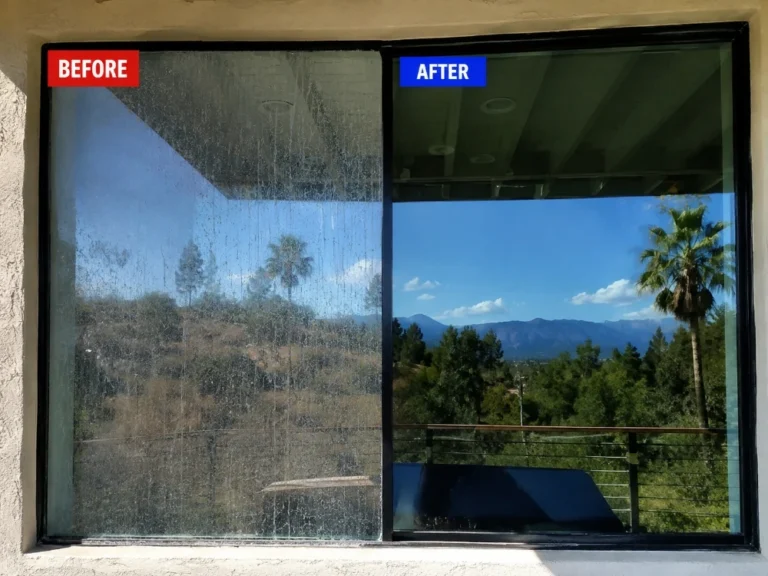
Quick answer: Salt film on glass is reversible with professional cleaning using purified water. Chemical etching from prolonged salt exposure is permanent — no cleaning or treatment restores etched glass. The difference comes down to how long the salt has been on the glass and how many wet-dry cycles it has gone through.
Living near the Pacific in San Clemente means your windows are in a continuous salt environment. The marine layer deposits salt aerosol on glass surfaces whether it’s rained or not, and that salt behaves differently than the dust and grime that accumulates on inland glass. Understanding the difference between reversible salt film and permanent etching damage determines how you maintain your windows — and how much it eventually costs.
The Mechanism: How Salt Damages Glass
Sodium chloride (table salt) is hygroscopic — it absorbs moisture from the air. On a San Clemente window, salt aerosol from the Pacific lands on the glass surface and immediately begins absorbing moisture from the marine layer. This keeps the salt chemically active, in a continuous wet-dry cycle driven by the daily pattern of marine layer humidity burning off in the afternoon.
In this active state, the salt doesn’t just sit on the glass — it begins chemically interacting with the silica (SiO2) that glass is made of. Over time, the sodium ions in the salt exchange with the silicon ions in the glass surface, creating sodium silicate in the top molecular layers of the glass. This is the beginning of etching.
Stage 1: Salt Film (Weeks 1–8) — Fully Reversible
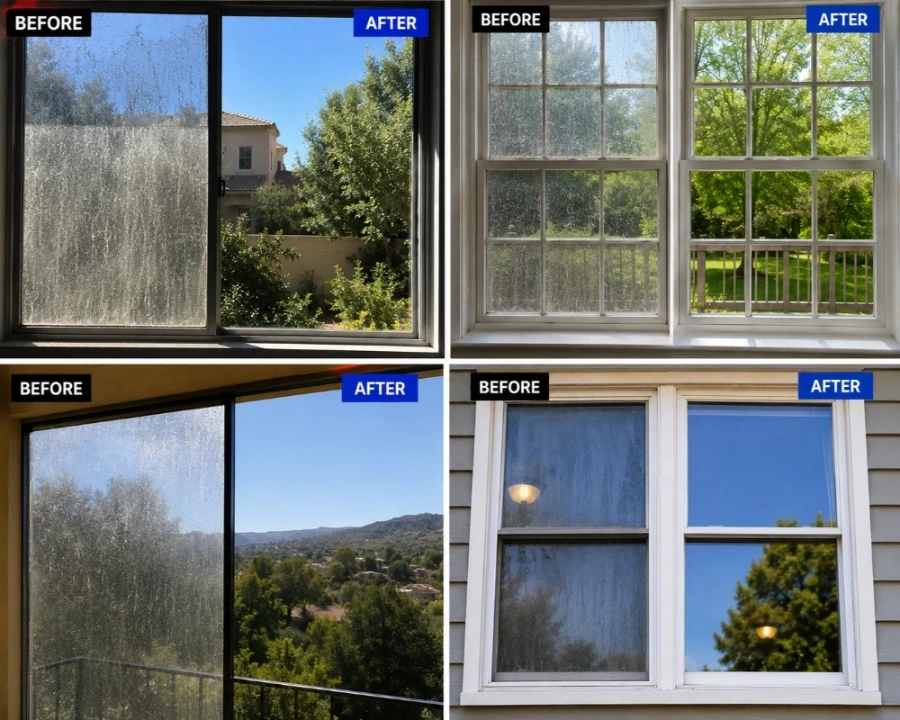
Fresh salt film is a surface deposit sitting on top of the glass. It looks like a milky haze or thousands of tiny white specks when viewed at an oblique angle in direct light. This stage is fully reversible: professional cleaning with purified water (RO + deionized, below 10 ppm TDS) removes the deposit completely and restores full glass clarity.
Critical detail: tap water cannot effectively remove salt film because San Clemente municipal water contains 200–350 mg/L of dissolved minerals. Using tap water to clean salt-filmed glass deposits new minerals as the water evaporates, partially replacing the salt film with a calcium carbonate film. Purified water with zero dissolved solids leaves nothing behind as it dries.
Stage 2: Bonded Salt Film (Weeks 8–16+) — Reversible With More Work
Salt film that has gone through many wet-dry cycles begins bonding more strongly to the glass surface and starts incorporating mineral deposits from irrigation overspray. The film is thicker and requires more passes to remove. Standard cleaning technique isn’t enough — this stage requires the pre-job assessment to identify severity, proper dwell time with cleaning solution, and a TDS-verified purified water rinse. It comes off, but takes significantly longer per window.
Stage 3: Early Etching (Months 4–12) — Partially Reversible
The beginning of permanent glass damage. The sodium-silica exchange has altered the top molecular layers of the glass. Cleaning removes the surface salt deposit, but the altered glass surface beneath remains — appearing as a slightly matte or hazy finish that doesn’t fully clear even after professional cleaning.
At this stage, glass restoration abrasives (cerium oxide or diamond pads) can improve clarity by removing the altered surface layer, but the process is expensive, time-consuming, and not always fully effective depending on severity.
Stage 4: Deep Etching (12+ Months) — Permanent
Significant structural damage to the glass surface. The etching is deep enough that abrasive restoration cannot fully remove it. The only options are glass restoration specialists (rare, expensive, limited effectiveness) or glass replacement.
Visually: deep etching looks like a permanent frost — the glass appears hazy whether clean or dirty, wet or dry. Running a finger across the surface often reveals a slightly rough texture where the glass has lost its original smooth float surface.
The Wet Glass Test
To assess where on this scale your glass is: wet the entire window with clean water. Observe while wet, then watch as it dries. If the glass is fully clear when wet and hazy only when dry — Stage 1 or 2, reversible. If the glass is slightly hazy even when wet — Stage 3, partially reversible. If the glass looks the same wet and dry — Stage 4, permanent damage.
Which Properties Are Most at Risk
Risk is primarily determined by ocean exposure and time between cleanings. Ocean-facing glass in direct wind corridors on Beach Road, Cyprus Shore, Pier Bowl, and Cotton Point Estates is at the highest risk of rapid progression through these stages. A Pier Bowl home with no professional cleaning in two years may already have Stage 3 damage on the most exposed panes. A Talega home two years without cleaning has hard water deposits — a different problem entirely, but also a serious one.
Not Sure What Stage Your Glass Is At?
The pre-job assessment at the start of every visit identifies etching, deposits, and failed seals — before we start, not after. No obligation to book if the damage is beyond what cleaning can fix.
📞 Call (949) 387-4521Related Articles
The Long-Term Cost of Ignoring Salt Air Damage in San Clemente
Salt air window damage in San Clemente follows a predictable and preventable cost curve. In year one of neglect, the damage is cosmetic — salt film and light deposits that professional cleaning reverses completely at standard rates. By year two, secondary bonding has begun and acid treatment is needed alongside cleaning, adding $80–$200 per visit. By year three, light etching is present on the most exposed panes — partial restoration with cerium oxide polishing at $150–$400 per pane, with 60–80% clarity recovery. By year four or beyond, deep etching requires pane replacement at $300–$800 per pane for standard residential sizes, and potentially more for picture windows or custom glazing.
The cumulative cost of four years of neglect on a ten-pane ocean-facing elevation in Pier Bowl: year one (no action, salt film accumulates) = $0 spent, $0 damage. Year two (acid treatment needed) = $200 treatment + $280 standard clean = $480 for that year’s first clean. Year three (light etching) = $250 polishing per affected pane × 4 panes = $1,000 + ongoing cleaning costs. Year four (deep etching) = $600 per pane replacement × 6 panes = $3,600 + installation. Total avoidable cost: $5,000+ for a decade of standard cleaning and acid treatment (~$400–$600 per year).
Which San Clemente Areas Are at Highest Risk
Salt air damage risk in San Clemente is directly proportional to Pacific exposure and elevation. The highest-risk properties are in this order: (1) direct oceanfront on Beach Road, Pier Bowl oceanfront, T-Street beachfront — 6-week cycle essential; (2) bluff-top positions in Cyprus Shore, Cyprus Cove, and upper Pier Bowl — 6–8 week cycle; (3) North Beach and lower Riviera District below 100-foot elevation — 8-week cycle; (4) hillside with ocean view (Marblehead, upper Riviera) — 8–10 weeks; (5) inland communities with moderate west-facing exposure (Talega ridge, upper Forster Ranch) — 10–12 weeks; (6) fully inland and sheltered positions — 12–14 weeks. If you are unsure of your property’s exposure level, call us with your address and we will give you a specific recommendation based on our service history on your street.
Salt Air Window Damage — Prevention and Repair Guide for San Clemente Homeowners
Salt air window damage in San Clemente follows a three-stage progression that most homeowners do not recognise until they are already at stage two or three. Stage one is salt film — the white hygroscopic haze that appears within days of a clean on ocean-facing glass. Stage one is fully reversible at any point. Stage two is mineral bonding — salt deposits that have been reactivated by repeated moisture cycling bond to the glass silica surface and can no longer be removed by standard cleaning. Stage two requires professional acid treatment but is still reversible. Stage three is glass etching — permanent chemical damage to the silica surface. Stage three is irreversible and requires either cerium oxide polishing (for light etching) or full pane replacement.
The critical insight is that the transition from stage one to stage two happens invisibly — there is no visual change in the glass that indicates deposits have shifted from cleanable to acid-treatment-only. The transition from stage two to stage three also happens below the visible threshold until etching is already established. This is why the cleaning cycle matters: it is not about aesthetics between cleans but about keeping deposits in stage one, where standard professional cleaning resolves them completely.
What Salt Damage Looks Like at Each Stage
- Stage 1 — Salt film: White or grey haze visible from certain angles. Disappears when glass is wet. Returns when dry. Fully reversible with professional purified-water cleaning.
- Stage 2 — Mineral bonding: Haze that does not disappear when glass is wet. White crystalline patches that feel slightly rough to the touch. Standard cleaning reduces but does not eliminate. Requires professional acid treatment to resolve.
- Stage 3 — Glass etching: Haze that remains after acid treatment. May show rainbow interference patterns (iridescence) in direct sunlight. Rough texture on the glass surface. Partially restorable with cerium oxide polishing at $150–$400 per pane. Deep etching requires pane replacement at $300–$800 per pane.
Salt Damage Prevention — The Only Strategy That Works
The only reliable prevention for salt air window damage is a consistent professional cleaning schedule using TDS-verified 0 ppm purified water. No coating, film, or surface treatment applied to glass prevents salt aerosol deposition — the physics of hygroscopic salt crystals mean they will bond to any surface given enough time and moisture cycling. Some products claim to repel water and slow salt accumulation — and they do, for a period. But they do not prevent accumulation, only delay it, and they add their own chemistry to the glass surface that complicates future professional cleaning. We do not recommend hydrophobic coatings for San Clemente coastal glass. We recommend a consistent cleaning cycle as the only genuinely effective prevention.