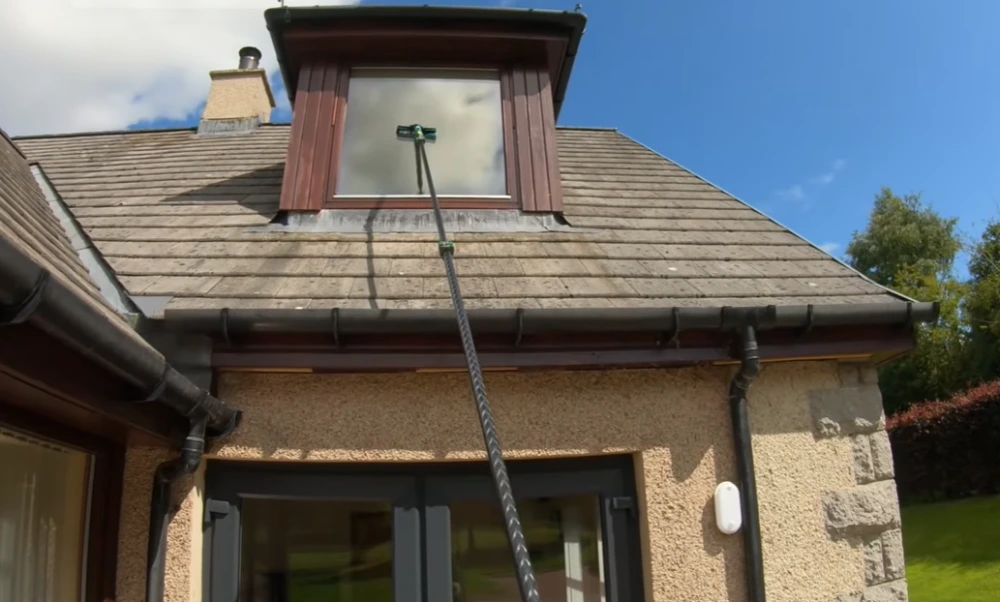
Hard Water Stains San Clemente Windows
Hard Water Stains on San Clemente Windows: Why They Keep Coming Back and How to Actually Fix Them
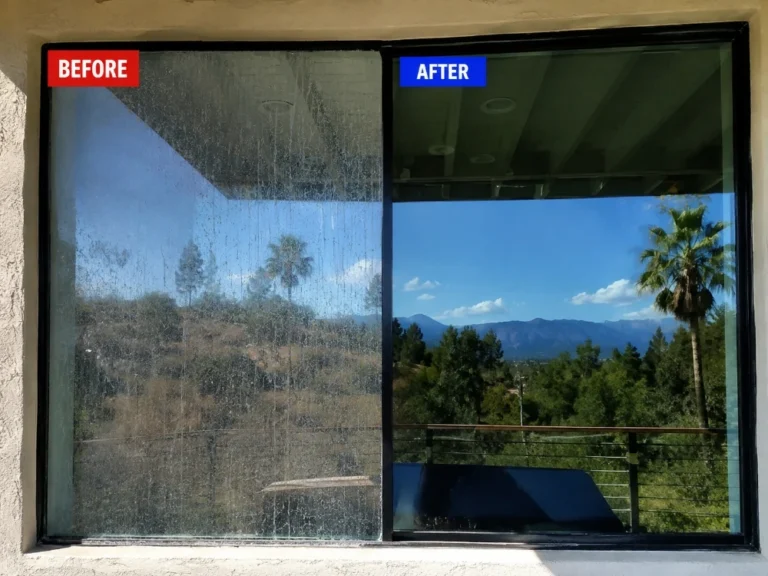
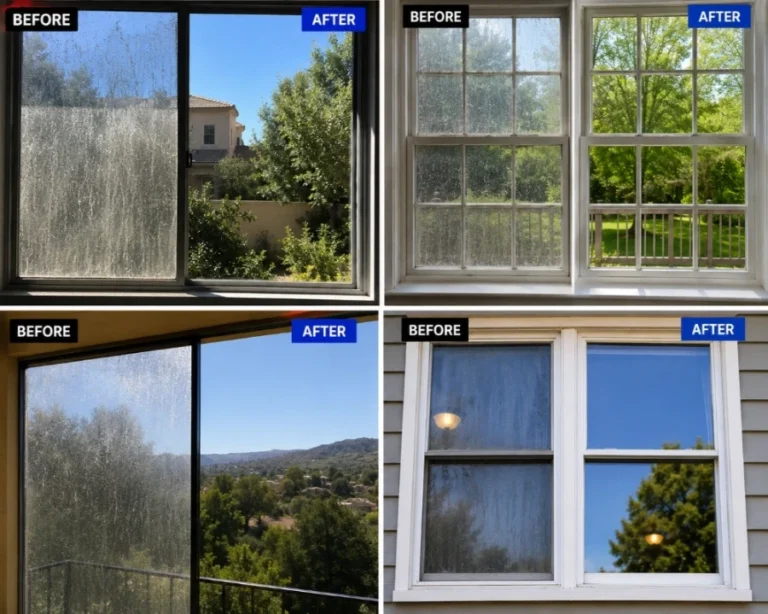
If you live in Talega, Marblehead, or Forster Ranch and have white, chalky spots on your windows that don’t respond to cleaning — regardless of how many times a cleaner has been out — this post is specifically for you. The spots are not dirt. Standard cleaning doesn’t remove them. And the reason they keep coming back is almost certainly your irrigation system.
What Hard Water Stains Actually Are
San Clemente’s municipal water supply carries 200–350 mg/L of dissolved calcium and magnesium carbonates — the same minerals that coat your shower head and leave white residue in your coffee maker. When this water hits your windows from a sprinkler and evaporates, the minerals stay behind as a chemical bond with the glass surface. Not sitting on top of it. Bonded to it.
This is why regular glass cleaner doesn’t work. You’re trying to wipe off something that has chemically fused to the glass. Standard cleaning removes everything that’s merely sitting on the surface — salt film, dust, loose grime — but leaves calcium carbonate deposits entirely untouched.
How to identify hard water deposits vs. salt film: Hard water deposits look chalky white, appear only on windows directly in the path of sprinkler spray, and don’t sparkle. Salt film appears as a general haze across all exposed glass and may show ring-shaped crystals at a 60-degree angle in sunlight. They require different treatments.
Why They Keep Coming Back
Three reasons hard water deposits persist on San Clemente windows:
1. The source isn’t fixed
If a sprinkler head is still hitting your windows, every cleaning is temporary. The deposits come back within weeks because you’re cleaning the result while the cause continues. The fix requires redirecting or adjusting the specific heads responsible — something most window cleaners won’t mention because it reduces their recurring work.
2. Previous cleaners used the wrong chemistry
Calcium carbonate deposits require dilute acid chemistry to dissolve — typically oxalic or phosphoric acid at controlled concentrations with specific dwell time. Standard soap-and-water window cleaning doesn’t touch them. Many homeowners have paid for “hard water removal” from cleaners who simply scrubbed harder with the same chemistry. The deposits don’t respond to pressure — they respond to acid.
3. The deposits may have partially etched
Left for years, calcium carbonate deposits can begin physically etching the glass surface — especially when combined with UV exposure. At that point, even acid treatment removes most but not all of the cloudiness. The portion that remains is in the glass, not on it. This is why early treatment matters.
The Actual Solution
A proper hard water treatment on San Clemente windows involves:
- Pre-inspection to assess deposit severity and identify which windows are affected
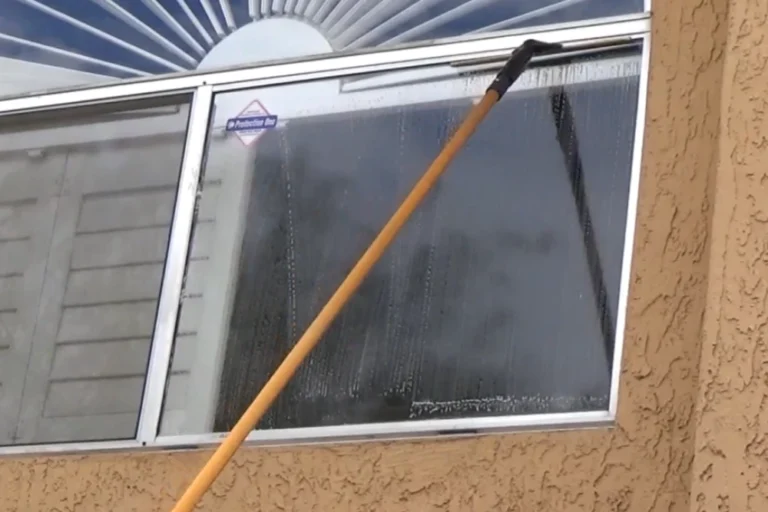
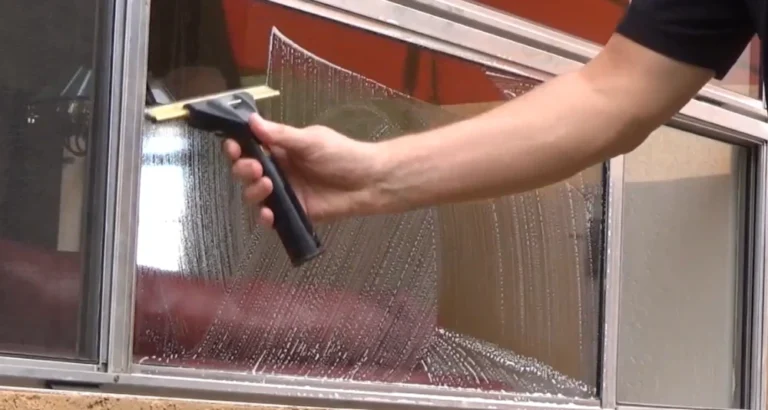
- Dilute acid application (oxalic or phosphoric) with controlled dwell time — the specific dwell time depends on deposit thickness and age
- Neutralization with TDS-verified purified water rinse
- Post-treatment assessment — honest disclosure of any areas where deposits have begun permanent etching
- Sprinkler head identification and redirection recommendation
One treatment often resolves years of accumulation. But without fixing the irrigation source, deposits return within months.
What Hard Water Treatment Costs in San Clemente
Treatment is quoted separately from standard window cleaning after a pre-job inspection confirms which windows are affected and the severity. Typical ranges: mild deposits add $80–$120; moderate bonded deposits add $100–$200. Severe cases with possible etching are assessed individually.
It’s never added to your bill without your knowledge. Assessment happens first, quote given, then you decide.
White Spots That Won’t Go Away?
Tell me your neighborhood and how long the spots have been there. I can usually tell you whether they’re treatable before I even visit.
📞 Call (949) 387-4521Related: Salt Air and Hard Water Damage Guide · Window Cleaning Talega · Window Cleaning Marblehead
The Chemistry Behind Hard Water Stains on San Clemente Windows
San Clemente’s municipal water supply arrives from the Colorado River at 500–700 parts per million Total Dissolved Solids — primarily calcium carbonate (limestone), magnesium sulfate, and silica. When this water contacts a glass surface — from irrigation overspray, condensation runoff, or tap-water window cleaning — and then evaporates, these dissolved minerals are left behind as a crystalline deposit on the glass surface.
The first deposits are soluble — they can be dissolved and wiped away with the right acid chemistry. Over time, repeated mineral cycling (wet-dry-wet-dry from irrigation schedules or weather patterns) causes the calcium carbonate to undergo a secondary bonding process. The mineral deposit becomes insoluble and bonds chemically to the silica in the glass surface itself. This is when hard water stains become genuinely difficult to remove — not because of how thick they are, but because of how strongly they are bonded.
Professional Acid Treatment — What Actually Works
Professional hard water removal uses a buffered acid solution (typically phosphoric or hydrofluoric acid at controlled concentration) applied to the glass surface at appropriate dwell time. The acid dissolves the calcium carbonate bond without damaging the glass silica if the pH and contact time are correctly managed. This is the step that separates professional treatment from DIY approaches — the risk of over-etching the glass with too strong an acid or too long a contact time is real, and the damage is permanent.
We assess the deposit age and severity before starting. Light deposits (under 12 months of accumulation) typically clear completely in one treatment. Moderate deposits (12–24 months) usually require two treatments. Heavy deposits (2+ years) show significant improvement in one treatment but may need follow-up. We tell you honestly what result to expect before we start and quote additional treatments if needed — we will not promise full removal on a 3-year-old deposit and then bill you for partial results.
Preventing Hard Water Stains — The San Clemente Homeowner Approach
The single most effective prevention measure is redirecting irrigation systems so spray heads do not reach window glass. This is the source of 80% of severe hard water staining on San Clemente residential windows. A licensed irrigation technician can adjust spray head direction and coverage for a few hundred dollars — an investment that eliminates the most damaging source of mineral contamination from your glass permanently.
If irrigation adjustment is not practical, professional window cleaning on a regular schedule with 0 ppm purified water prevents mineral accumulation. Purified water carries no dissolved minerals — when it evaporates from glass it leaves nothing behind. Regular cleaning removes light deposits before they undergo secondary bonding, keeping glass treatable by standard cleaning alone. The alternative — allowing deposits to build over 12–24 months — typically ends with an acid treatment bill of $80–$200 added to the base clean price.
The Stages of Hard Water Damage — And What Each Stage Costs to Fix
Hard water glass damage in San Clemente progresses through three distinct and increasingly expensive stages. Understanding which stage your glass is at determines what service you need and what result to expect. Stage 1 (0–6 months of accumulation): soluble calcium carbonate deposits that have not yet undergone secondary bonding to the glass silica. These are fully reversible with professional acid treatment in one visit. Cost to fix: $80–$200 added to base clean price. Stage 2 (6–18 months): calcium deposits that have undergone secondary bonding — they have partially crystallised into the glass surface. Professional acid treatment removes 70–90% of the deposit in one visit, with a follow-up treatment needed for full resolution. Cost to fix: $160–$400 for two treatments. Stage 3 (18+ months): deep calcium bonding combined with the beginning of silica etching beneath the deposit layer. Acid treatment removes the calcium but reveals permanent etching underneath. The glass is permanently hazed in the affected area. Cost to fix: cerium oxide polishing at $150–$400 per pane, with 60–80% clarity recovery. Beyond polishing, pane replacement is the only option.
The intervention cost difference between Stage 1 and Stage 3 is stark: a Stage 1 clean costs $80–$200 in addition to the base service. Stage 3 remediation costs $150–$400 per pane just for polishing — multiplied by however many panes are affected. A five-pane elevation at Stage 3 costs $750–$2,000 to restore, versus $100–$150 at Stage 1. The case for early professional intervention is entirely financial, not aesthetic.
Irrigation Adjustment — The Prevention That Costs Less Than One Treatment
The most effective hard water prevention measure for San Clemente homes with automated irrigation is adjusting the spray head coverage so water does not reach window glass. Most residential irrigation systems can be adjusted by a licensed irrigation technician for $150–$300 — a one-time cost that eliminates the primary source of calcium deposits permanently. We recommend this adjustment to any San Clemente homeowner whose lower-story glass shows calcium deposits from irrigation. It is the single highest-return maintenance investment available for properties where irrigation reaches windows. Once the source is eliminated, regular purified-water cleaning prevents any further accumulation, and acid treatment becomes a once-in-several-years exception rather than an annual cost.