Remove Hard Water Stains — San Clemente
How to Remove Hard Water Stains From Windows in San Clemente (And When You Can’t)
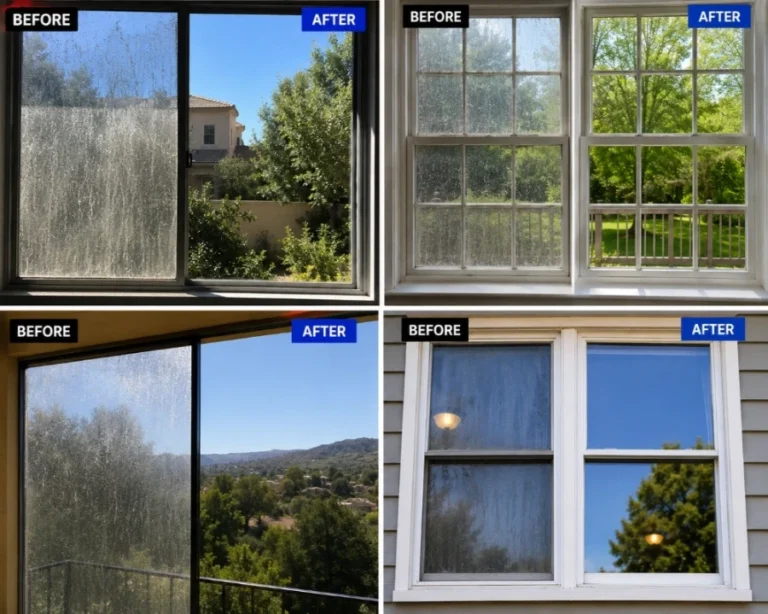
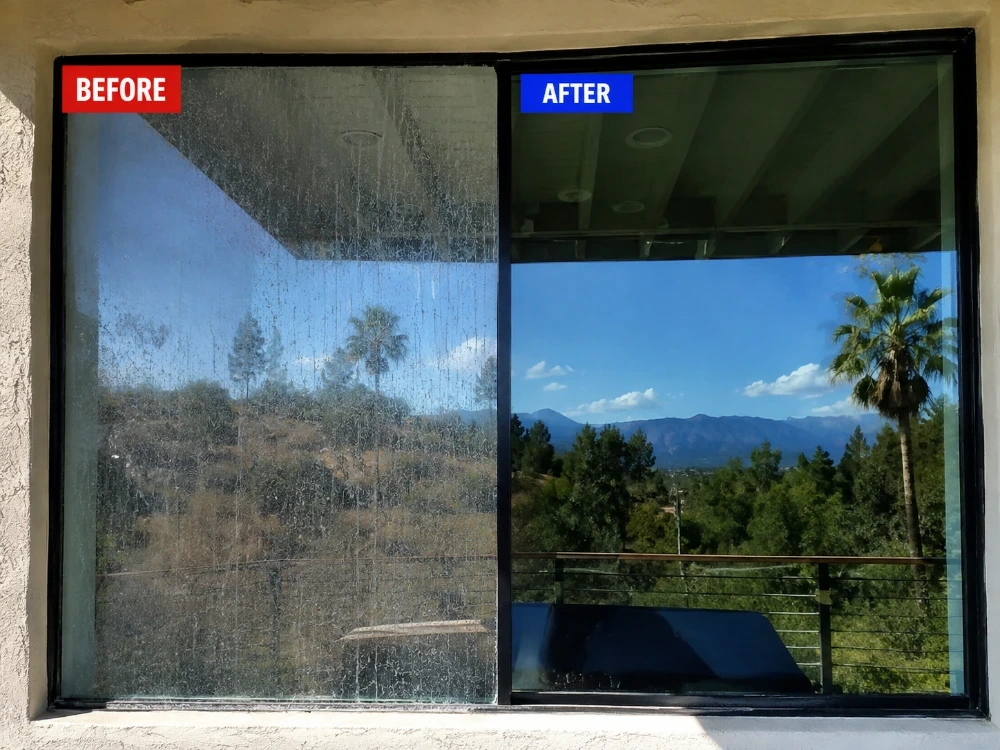
Quick answer: Hard water mineral deposits (white chalky stains from irrigation overspray) require dilute acid chemistry — not standard glass cleaner, not vinegar, not a razor blade. Most San Clemente cases can be professionally treated. But if the glass is etched, the damage is inside the glass and no treatment reverses it.
White spots on San Clemente windows that don’t respond to cleaning are one of the most common calls we get. Homeowners have tried glass cleaner, vinegar, Magic Eraser, even razor blades — and the spots either won’t budge or come back immediately. This guide explains why, and what actually works.
What Are Hard Water Stains on Windows?
The white cloudy deposits on your windows are calcium carbonate — the same mineral compound that builds up in shower heads, kettles, and dishwashers. They form when water containing dissolved calcium and magnesium (San Clemente’s municipal supply runs 200–350 mg/L of these minerals) evaporates off the glass surface, leaving the minerals behind.
In most San Clemente homes, the source is irrigation overspray. A sprinkler head aimed slightly toward a window deposits mineral-rich water on the glass on every irrigation cycle. Over months and years, the deposits build layer by layer, forming an increasingly thick mineral crust that’s chemically bonded to the glass surface.
The chemistry problem
Calcium carbonate forms a crystalline bond with glass that standard soap and water can’t break. The soap molecules can’t penetrate the mineral crust to reach the glass surface underneath. This is why the spots return immediately after standard cleaning — the cleaner is washing around them, not removing them.
What Actually Works: Dilute Acid Treatment
The only safe and effective way to remove calcium carbonate deposits from glass is acid chemistry. The acid reacts with the calcium carbonate and converts it into calcium acetate or calcium phosphate, which dissolves in water and rinses away cleanly.
The acids used professionally are dilute oxalic acid or dilute phosphoric acid — both are mild organic acids safe for glass when applied at the correct concentration with controlled dwell time. They’re not the harsh industrial acids that damage glass; the mechanism is purely chemical dissolution of the mineral deposit.
Why DIY acid attempts often fail or cause damage
- White vinegar (acetic acid) — Too weak at grocery-store concentration for established mineral deposits. Works on fresh, light deposits only.
- CLR and similar products — Stronger but not formulated for glass. Can etch soft glass coatings (Low-E) and may leave residue.
- Razor blades — Scratch glass. Never use on modern float glass or any coated glass.
- Abrasive pads — Same problem. Micro-scratches create hazing that’s permanent.
How We Treat Hard Water Stains at San Clemente Window Cleaning
- Pre-job assessment — Identify which windows have mineral deposits vs. salt film vs. etching. Not all hazy windows have the same problem.
- Test area — Apply dilute acid to a small corner and observe reaction. This confirms the deposit type and rules out Low-E coatings that require different chemistry.
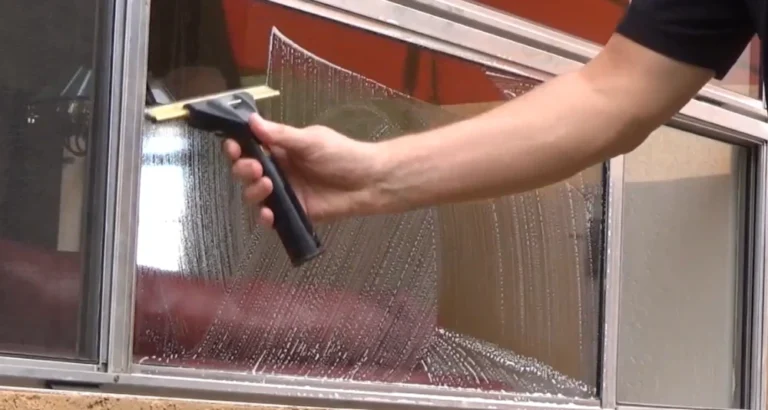
- Controlled acid application — Applied with a microfiber applicator, allowed specific dwell time based on deposit thickness. Not left to dry — timing matters.
- Purified water neutralization rinse — RO + deionized water flushes the dissolved minerals and acid completely. Tap water at this stage would redeposit minerals.
- Assessment — Most deposits clear in one treatment. Severe multi-year buildup may require a second pass.
Which San Clemente Neighborhoods Have the Worst Hard Water Problems?
Talega is the most common source of hard water calls. The combination of San Clemente’s mineral-rich municipal water, automated irrigation systems throughout the community, and the fact that many homes have sprinkler heads aimed near or directly at windows creates ideal conditions for severe mineral deposits. We’ve treated Talega windows with 5+ years of uncleaned calcium carbonate buildup that standard cleaning couldn’t touch.
Marblehead, Forster Ranch, and Rancho San Clemente have similar profiles. Hillside homes with terraced landscaping frequently have irrigation overspray hitting lower-story windows.
Pier Bowl and coastal neighborhoods have a different issue — salt film rather than hard water deposits. The treatment is different (salt responds to standard cleaning with purified water; calcium carbonate requires acid).
When Hard Water Stains Can’t Be Removed
If the calcium carbonate has been on the glass long enough, or if the glass was repeatedly scrubbed with abrasives in an attempt to remove the deposits, the glass surface itself may be damaged. This appears as permanent haze that looks the same wet and dry — classic etching.
The test: wet the window completely. If the haze disappears when wet and returns as the glass dries, the deposits are still on the surface — treatable. If the haze looks identical wet and dry, the glass is etched — not treatable by cleaning.
Etched glass options: professional glass restoration grinding (expensive, requires specialist equipment) or glass replacement. Standard window cleaning, including acid treatment, won’t improve etched glass.
How to Prevent Hard Water Stains From Coming Back
The single most effective prevention is redirecting irrigation heads away from window glass. If a sprinkler head isn’t hitting a window, the window can’t get mineral deposits from that source. We flag misaimed heads during every job and point them out before leaving — it prevents the call-back.
Got White Spots That Won’t Come Off?
We’ll assess the deposits honestly before starting — including telling you if the glass is already etched and treatment won’t help.
📞 Call (949) 387-4521Related Pages
Removing Hard Water Stains — What San Clemente Professionals Do Differently
Professional hard water stain removal uses chemistry and technique that is unavailable to homeowners through standard retail channels. The active chemistry is buffered phosphoric acid or hydrofluoric acid at controlled concentration — compounds regulated for professional use because the margin between effective and damaging application is narrow. The technique involves applying the acid solution at the correct pH for the specific deposit age, maintaining contact for a precisely timed dwell period, and neutralising completely before rinsing. Too short a dwell and the deposits are incompletely dissolved. Too long and the acid begins etching the glass silica surface underneath — creating permanent damage that the treatment was supposed to prevent.
DIY hard water removal products available in home improvement stores contain either weak acid (citric acid or diluted white vinegar) or mild abrasive compounds. Citric acid and vinegar are effective on Stage 1 deposits (under 6 months, soluble calcium carbonate) but have negligible effect on Stage 2 or Stage 3 bonded deposits. Abrasive compounds physically remove deposits but scratch the glass surface in the process — a permanent cosmetic defect that is visible under raking light and reduces the optical clarity of the glass even when otherwise clean. We advise against abrasive DIY treatment on any glass that is visible or of aesthetic importance to the homeowner.
After Professional Hard Water Removal — Maintaining Clarity
Once hard water deposits are professionally removed and the glass is clean, maintaining that result requires two things: switching to purified water for all future cleaning (to prevent new mineral deposits from cleaning water itself) and addressing the irrigation source if overspray is reaching windows. A professionally cleaned San Clemente window maintained with 0 ppm purified water cleaning on the right schedule should never need acid treatment again. The acid treatment is a restoration service — it should not become a recurring expense. If your windows need acid treatment every clean, the source contamination has not been addressed. We identify and advise on contamination sources as part of every hard water removal service.