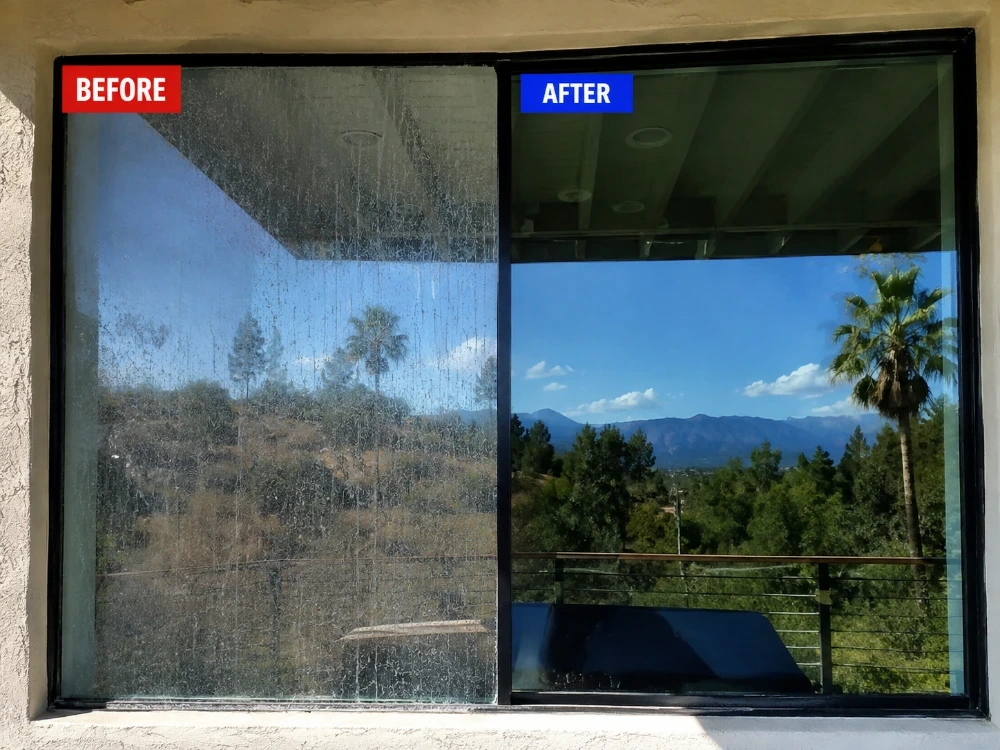
How Often to Clean Windows San Clemente
How Often Should You Clean Windows in San Clemente, CA? (By Neighborhood)
Quick answer: Pier Bowl, North Beach, T-Street, Cyprus Shore — every 6–8 weeks. Marblehead, Riviera District — every 8–12 weeks. Talega, Forster Ranch, Rancho San Clemente — every 12–16 weeks. The interval is determined by your neighborhood’s salt aerosol exposure, not by how dirty the glass looks.
The most common question we get from San Clemente homeowners is some version of: “How often do I actually need professional window cleaning?” The honest answer is that it depends almost entirely on where your home sits relative to the Pacific Ocean — and most homeowners are going longer between cleans than their glass can handle.
This guide breaks down the recommended cleaning frequency for every major San Clemente neighborhood, explains the science behind the intervals, and tells you how to know when your glass has been neglected too long.
Why San Clemente Windows Need More Frequent Cleaning Than Inland Homes
The mechanism is specific: Pacific Ocean water evaporates into aerosol droplets that carry dissolved sodium chloride. These droplets travel inland on prevailing onshore winds and land on every surface, including glass. Salt is hygroscopic — it absorbs moisture from the air — which means it stays chemically active on glass surfaces rather than drying out and becoming inert the way inland dust does.
On a home in Irvine or Anaheim, dust lands on glass and sits there passively. It looks dirty, but it’s not doing any damage. On a home in San Clemente’s Pier Bowl, salt film lands, absorbs moisture from the marine layer, and begins chemically reacting with the silica in the glass surface. Given enough time and repeated cycles, this etches the glass permanently. Once etching occurs, no cleaning can reverse it.
This is why the frequency recommendation for coastal San Clemente homes is measured in weeks, not months.
Cleaning Frequency by Neighborhood
Every 6–8 Weeks: High Ocean Exposure Zones
These neighborhoods receive direct onshore wind from the Pacific with minimal geographic buffering. Salt aerosol concentrations are highest here, and during peak marine layer season (June through September), 6 weeks is the recommended maximum interval.
- Pier Bowl & Beach Road — Direct ocean exposure. Some properties are within 100 feet of the water. 6 weeks during marine layer season, 8 weeks off-season.
- North Beach — Beach-adjacent, one of the highest salt concentrations in the city. Same interval as Pier Bowl.
- T-Street — Surf beach corridor with direct coastal exposure. Bungalows and beach houses here accumulate salt film fastest.
- Cyprus Shore & Cyprus Cove — Gated oceanfront communities. Ocean-facing glass on these properties is in a near-constant salt environment.
- Cotton Point Estates — San Clemente’s southernmost coastal estate community. Maximum Pacific exposure.
- Riviera District — Bluff-top properties above the beach. Elevated position means slightly less direct spray, but still high exposure.
Every 8–12 Weeks: Mid-Exposure Hillside Neighborhoods
These neighborhoods have ocean views and receive salt aerosol, but their hillside elevation and greater distance from the water buffers direct exposure somewhat. Hard water mineral deposits from irrigation are also a factor here.
- Marblehead — Hillside Spanish Colonial homes with ocean views. Mid-elevation provides some wind buffering. Irrigation mineral deposits are common on lower windows.
- Shorecliffs — Mid-coastal elevation, older neighborhood. Salt exposure moderate to high.
- Southwest San Clemente — Mixed exposure depending on specific street and elevation.
Every 12–16 Weeks: Inland HOA Communities
These neighborhoods are inland enough that salt aerosol is significantly reduced. The primary contaminant shifts from salt to hard water mineral deposits from irrigation systems.
- Talega — Golf community several miles inland. Salt aerosol minimal. Hard water from irrigation overspray is the dominant issue, requiring acid treatment rather than standard cleaning on affected windows.
- Forster Ranch — Canyon terrain provides additional wind buffering. Hard water and canyon dust (especially during Santa Ana events) are the primary contaminants.
- Rancho San Clemente — Hillside inland community. Similar profile to Forster Ranch. 16 weeks is a reasonable maximum for homes without significant irrigation overspray on windows.
How to Tell If Your Windows Have Been Neglected Too Long
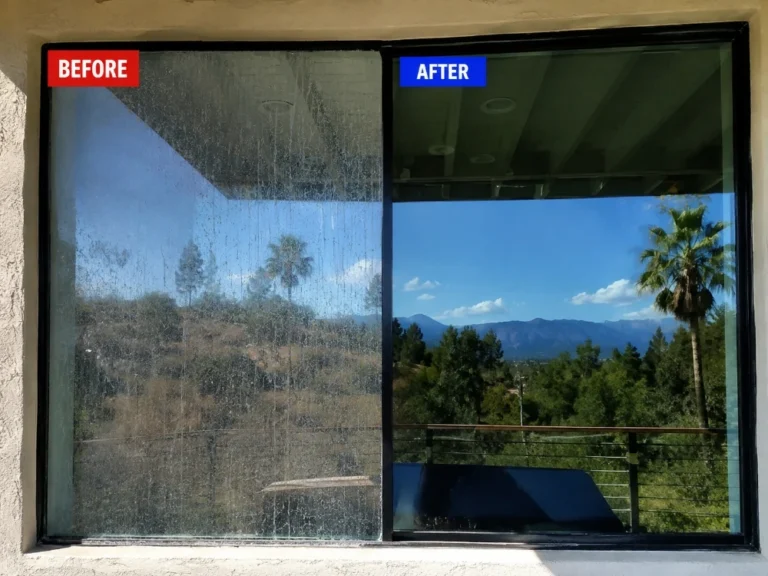
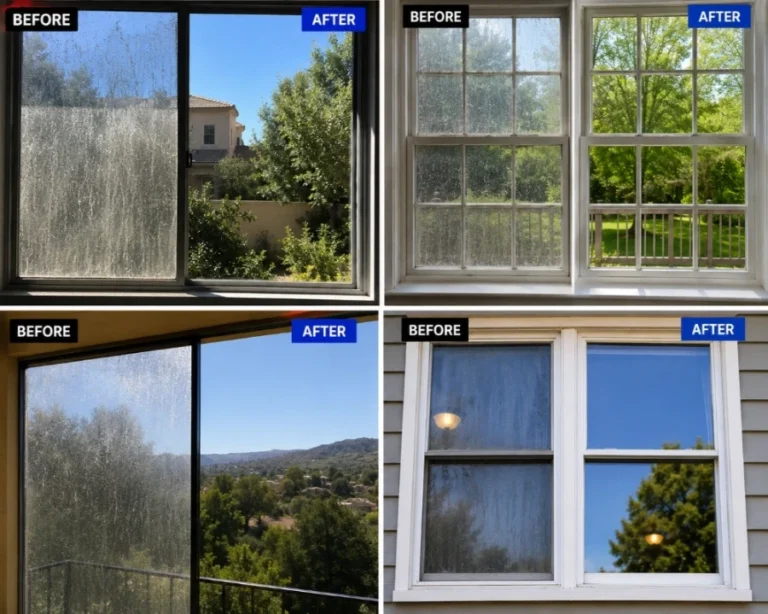
The field test: wet the glass thoroughly with clean water and observe what happens. If the haze largely disappears when wet and returns as the water dries — that’s a surface deposit. Reversible with professional cleaning. If the glass looks the same wet and dry — same uniform matte haze — that’s characteristic of chemical etching. Not reversible.
For hard water deposits (common in Talega and Forster Ranch): look for white chalky patches that don’t respond to standard glass cleaner. These require dilute acid chemistry to remove and won’t come off with squeegee technique regardless of how much effort is applied.
What Happens If You Wait Too Long
In high-exposure coastal neighborhoods, the damage progression is:
- Weeks 1–8: Salt film accumulates. Reversible with professional cleaning.
- Weeks 8–16: Salt film thickens and begins bonding with mineral deposits. Still removable but requires more work. First-clean pricing applies.
- Months 6–12: Chemical etching begins on ocean-facing glass. Partial reversal possible with abrasive restoration, but full clarity rarely recovered.
- 12+ months: Deep etching. Permanent. Glass replacement is the only remedy.
This timeline is specific to direct ocean-facing glass in neighborhoods like Pier Bowl and Cyprus Shore. Inland neighborhoods like Talega have a much more forgiving timeline — years of neglect typically means hard water deposits, not etching.
The Practical Answer
If you live within a half mile of the San Clemente coast and you’re not on a recurring cleaning schedule, you’re likely already behind. The 6–8 week recommendation isn’t marketing — it’s the interval at which salt film is removed before it can begin the etching process on high-exposure glass.
If you’re in Talega or Forster Ranch, you have more time, but the hard water buildup from irrigation systems is cumulative. One acid treatment visit often removes what years of standard cleaning couldn’t touch.
Find Out What Interval Your Home Needs
Tell me your neighborhood and I’ll give you an honest recommendation. Most San Clemente homes are quoted in under five minutes by phone.
📞 Call (949) 387-4521Related Articles
San Clemente Area Guides
Window cleaning needs vary significantly across San Clemente neighbourhoods. See our area-specific guides:
Signs Your San Clemente Windows Are Overdue for Cleaning
Most San Clemente homeowners know their windows need cleaning when they look obviously dirty. But the window before obvious dirt — the phase where contamination is building but not yet dramatic — is where the most damage occurs. Salt film in the early stages looks like a faint cloudiness on the glass that could be mistaken for interior condensation. Hard water deposits from irrigation appear as faint white rings around the perimeter of lower panes that might be attributed to the glass itself. The raking-light test reveals both: hold a phone torch at 20–30 degrees to the glass surface. If the glass haze disappears when you move the light to straight-on viewing, it is salt film. If it persists at all angles, it is either etching or calcium deposits.
The practical answer to how often: for Pier Bowl, Cyprus Shore, North Beach and T-Street homes, schedule cleaning before you think you need it — not when the glass already looks bad. At 4 weeks in summer your glass looks fine. At 6 weeks it looks borderline. At 8 weeks it needs a professional clean and may need acid treatment. At 12 weeks you are risking light etching. The cost of a clean at 6 weeks is the same as a clean at 12 weeks. The acid treatment add-on at 12 weeks is $80–$200 extra. The etching restoration at 16 weeks is $150–$400 per pane. The economics of cleaning before you need to are straightforward.
Setting Up a Recurring Schedule — How It Works
The simplest solution to the “how often” question is a recurring agreement where you book a cycle and we attend on schedule without you having to think about it. We offer 6-weekly, 8-weekly, 10-weekly, and 12-weekly (quarterly) recurring plans across San Clemente. Recurring clients receive 10% off the standard per-visit rate, locked at the time of agreement. No contract — cancel with 14 days’ notice. The agreement means your glass is always within the safe cleaning window for your location. Call (949) 387-4521 to discuss which cycle is right for your address.
The Marine Layer Calendar — Planning Your Cleaning Schedule
San Clemente’s marine layer follows a consistent annual pattern that should drive your window cleaning calendar. June through September is peak marine layer — morning fog arrives from the Pacific overnight, blankets the coast through mid-morning, then burns off. Each burn-off cycle deposits moisture on glass that reactivates existing salt deposits and accelerates bonding. During this period glass contamination compounds faster than at any other time of year. This is when the 6–8 week coastal cycle is most critical.
October through December sees marine layer frequency drop. Autumn Santa Ana events bring dry alkaline dust from the Ortega Canyon instead of Pacific moisture. January through March brings winter storms that actually flush glass naturally — rain is essentially free cleaning for salt-film contaminated glass, and a professional clean post-storm in March is often the most cost-effective service of the year. April and May sees salt build again ahead of the summer marine layer season — a professional clean in late April sets you up correctly for the high-risk summer period.
How to Find Your Correct Cleaning Cycle
The most practical way to find your correct cycle is to run one trial period after a professional clean and observe when visible haze reappears. If you see haze within 4–5 weeks, you need a 6-week cycle. If it appears at 7–8 weeks, an 8-week cycle is right. If glass stays clear past 10 weeks, extend to 12. This observation approach works because your home’s specific exposure — street orientation, elevation, distance from the ocean, tree canopy — is the determining factor, not a general rule.
Most San Clemente homeowners who do this find their correct cycle is shorter than they assumed. Years of tap-water cleaning typically leave a mineral base layer on glass that makes new salt bond faster than it would on truly clean glass. After the first one or two purified-water professional cleans, the correct cycle often extends — because genuinely clean glass accumulates contamination more slowly.