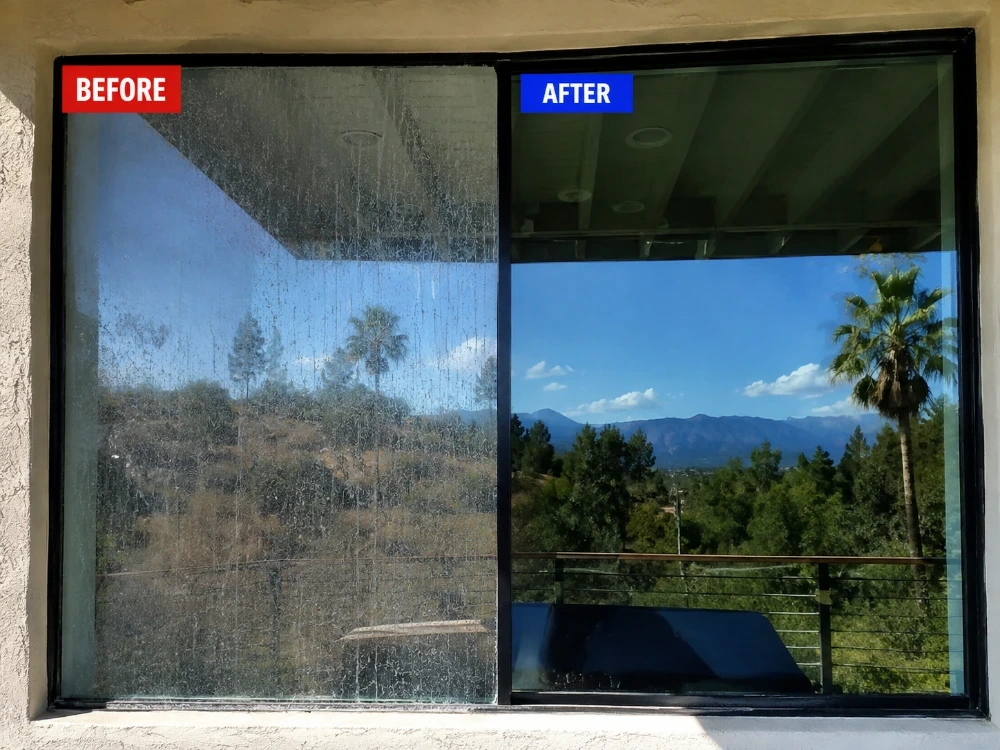
Diagnose Salt Film, Hard Water & Etching
Quick Answer: How do I know what is on my San Clemente windows?
Four different contaminants affect San Clemente windows — and they look and feel different. Salt film is a light haze visible mainly in raking sunlight. Hard water deposits are white, chalky spots or patches, usually near sprinkler zones. Marine layer haze is a semi-transparent grey film worst on ocean-facing glass. Glass etching is permanent — the glass looks cloudy in all light angles and feels slightly rough to the touch. Only the first three are cleanable. Etching requires restoration or replacement.
San Clemente homeowners often call us and describe their windows as “dirty” — but dirty is a starting point, not a diagnosis. The treatment for salt film is completely different from the treatment for hard water deposits, which is completely different from the treatment for glass etching. Getting the wrong treatment wastes money and can make the problem worse.
Here is how to read your own glass before you call.
Diagnosis 1: Salt Film
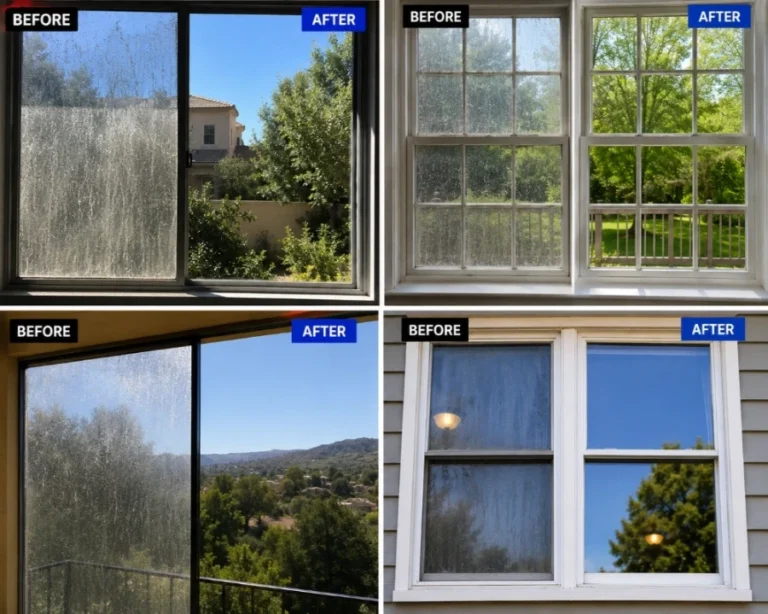
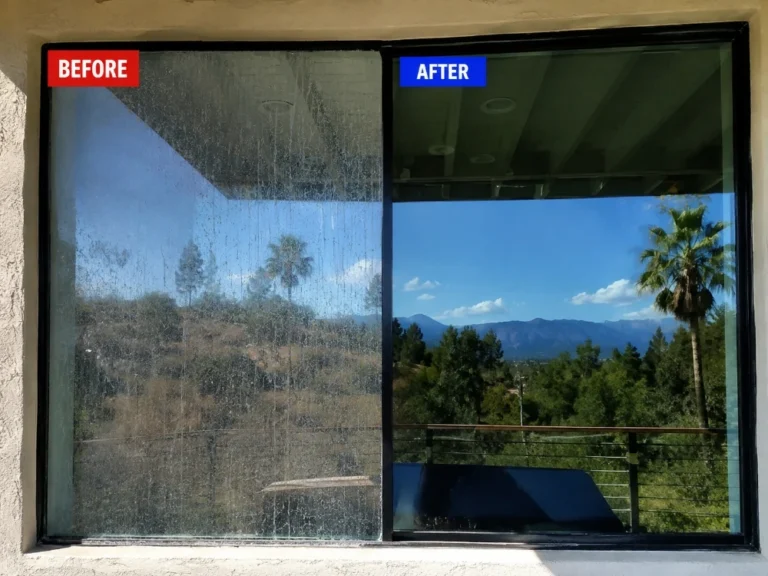
What it looks like: A semi-transparent haze most visible when you look at the glass in raking sunlight (sun hitting the glass at an angle, not straight on). Head-on, the glass may look acceptable. In direct sun from an angle, it appears grey-white and blocks the view clarity significantly. No distinct spots — just overall haze.
What it feels like: Slightly gritty or rough if you drag your fingernail across the exterior surface. In heavy accumulations near the ocean, you can feel a fine crystalline texture.
Where you will see it: Ocean-facing glass, upper storey windows, glass facing south or west. Worst in Pier Bowl, North Beach, Cyprus Shore, and T-Street. Worst in June–September during marine layer season.
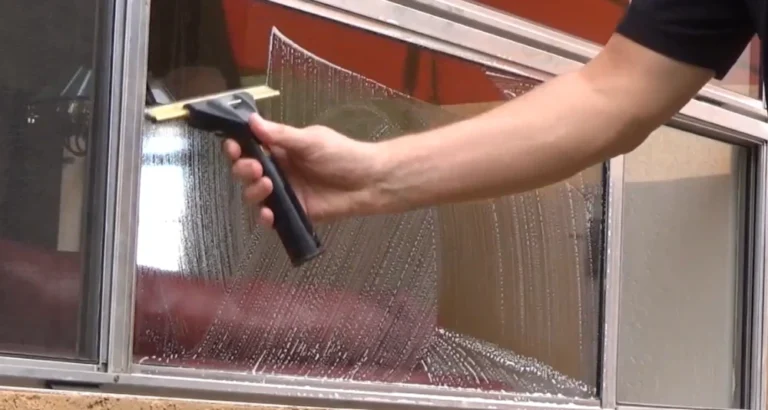
What it needs: Standard professional cleaning with purified water. For light accumulation (less than 4–6 weeks): one pass cleans it completely. For heavy accumulation (more than 8–10 weeks without cleaning): may need pre-treatment to break the salt bond before cleaning.
Is it reversible? Yes, if treated before it has etched the glass (typically before 60–90 days continuous exposure on ocean-facing glass).
Diagnosis 2: Hard Water Deposits
What it looks like: Distinct white or greyish-white spots, rings, or patches. Unlike salt film haze, hard water deposits have defined edges — the mark of where a water droplet dried. You can often see the shape of individual droplet evaporation. Around sprinkler zones, the pattern will follow the sprinkler’s arc.
What it feels like: Rough and slightly raised. If you run your finger across a hard water spot, it feels different from the smooth glass around it. You can feel the mineral deposit even when the surface appears dry.
Where you will see it: Ground-floor and lower second-floor windows near irrigation zones. Most common in Talega, Forster Ranch, and Rancho San Clemente where irrigation systems use Colorado River water. Also common near garden hoses, pool splash zones, and exterior hose bibs.
What it needs: Professional acid treatment (oxalic or citric acid at the correct pH and dwell time). Standard cleaning does not remove bonded calcium. DIY vinegar treatments are too weak for established deposits. The professional process: apply mineral removal solution, dwell, agitate with non-abrasive pad, rinse with deionised water.
Is it reversible? Usually yes, if the deposit has not etched the glass beneath it. Deposits less than 12 months old are almost always removable. Deposits older than 2 years may have etched the glass surface and require polishing or replacement.
Diagnosis 3: Marine Layer Haze
What it looks like: Similar to salt film but denser, with a slightly blue-grey tint rather than white. Visible both head-on and at an angle. Morning light (when marine layer has been active overnight) makes it most obvious. Glass that was clean yesterday can develop visible haze after a single night of marine layer exposure in peak season (June–August).
The marine layer test: Look at your ocean-facing glass at 7 AM on a foggy morning. If it looks cloudy or greyed from the inside, that is marine layer haze on the exterior surface. By midday after the marine layer burns off, the same glass may look acceptable — because the haze looks lighter in direct sun from inside. The morning test gives the accurate picture.
What it needs: Professional cleaning with purified water. Marine layer haze is a composite of dissolved salt aerosol, atmospheric particulates, and moisture — it cleans similarly to salt film. The key difference from salt film is that marine layer also contains organic compounds from the ocean that can be slightly stickier and may require a longer dwell of cleaning solution.
Diagnosis 4: Glass Etching (Permanent)
What it looks like: Cloudiness or haze that is present in all light angles — not just raking sunlight. Unlike salt film or marine layer haze, etched glass looks cloudy when you look straight through it in normal indoor light. The view is permanently impaired.
What it feels like: Run your fingernail across a cleaned, dry area. Etched glass feels slightly rough or matte compared to the smooth feel of intact glass. If a section of the same pane was protected (behind a plant, under an overhang) and that section feels smooth while the exposed section feels rough — that is etching.
The scratch test: Breathe on the glass (foggy breath) and look at the surface in raking light. Etched glass shows a network of microscopic scratches in the fog that are not visible when dry. Intact glass fogs evenly with no visible pattern.
Is it reversible? Sometimes. Light etching can be partially improved with professional glass polishing using cerium oxide compounds. Moderate etching is often partially restorable. Severe etching — visible cloudiness in normal viewing conditions — typically requires pane replacement. We assess etching honestly before quoting. We will tell you if we cannot improve a pane.
| Symptom | Likely Cause | Fix | Reversible? |
|---|---|---|---|
| Haze in raking light only | Salt film | Professional clean | Yes |
| White spots with defined edges | Hard water deposits | Acid treatment | Usually yes |
| Blue-grey haze, worse in morning | Marine layer | Professional clean | Yes |
| Cloudy in all light angles | Glass etching | Polishing or replacement | Partially |
| Rough surface feel after cleaning | DIY scratch damage | Polishing | Partially |
How do I know if my San Clemente windows are etched or just dirty?
Clean a small test section with a damp cloth. If the glass is clear and bright after cleaning, it is dirty (salt, hard water, or marine layer haze) and fully cleanable. If the glass still looks cloudy or hazy after being cleaned and dried, the glass surface itself is damaged (etched). A professional can assess whether the etching is light enough for polishing restoration or deep enough to require pane replacement. Call (949) 387-4521 for an honest assessment.
Not sure what is on your glass? We assess before we quote — and we tell you honestly what can be fixed and what cannot. No surprise charges, no work done on glass that cannot be improved. Call (949) 387-4521 for a same-week assessment in San Clemente.
📞 Get an Honest Glass AssessmentThe Diagnostic Process — How to Assess Your Own Windows
Before calling a professional, San Clemente homeowners can run a basic self-assessment to understand what they are dealing with. The assessment takes five minutes and tells you whether you need standard cleaning, acid treatment, or professional polishing — three different services at three different price points. Stand outside your home in the late afternoon when the sun is at a low angle to the west-facing glass. Look at the glass from three positions: straight on, at 30 degrees from the side, and at 30 degrees from below. Salt film is most visible from the side angle. Calcium deposits are most visible from below, particularly on lower-story panes. Etching is visible from all angles as a consistent haze that does not shift as you move.
Run your finger across a dry glass surface in a contaminated area. Salt film leaves a slight crystalline residue on your fingertip and may feel slightly rough. Calcium deposits feel rough and the white residue does not wipe off easily with a dry finger. Etching feels smooth — the glass surface is unchanged but the silica has been chemically altered to scatter light differently. If the residue wipes off with a damp cloth, you have cleanable contamination. If it does not, you need professional acid treatment. If there is no residue but persistent haze, you have etching — which requires polishing or pane replacement.
When to Stop Cleaning and Start Replacing
There is a point in glass deterioration where continued cleaning is not productive — where the glass surface has been etched to a degree that polishing will not restore clarity, and where pane replacement is the only path to optically clear glass. The indicators: haze persists after professional acid cleaning, the haze is uneven (deeper in some areas than others, suggesting differential etching from point-source contamination like irrigation heads), or the glass shows visible surface roughness to the touch even after cleaning. In these cases, professional polishing ($150–$400 per pane) may recover 60–80% of clarity. If the homeowner wants complete optical clarity, pane replacement ($300–$800 per pane for standard residential sizes) is the only option. We give honest assessments on first-visit inspections — we will not sell you repeated cleaning visits on glass that needs replacement.
Using a TDS Meter to Confirm Your Water Quality
The most reliable home diagnosis tool for San Clemente window contamination is a handheld TDS meter — available on Amazon for $12–$20. Dip it in your tap water and you will read 500–700 ppm. Dip it in purified water from a professional window cleaning system and you will read 0–10 ppm. This single test explains every mineral spot you have ever seen on San Clemente glass after cleaning — it is tap water chemistry, not inadequate cleaning technique.
Run the TDS meter test on your windows after your next cleaning visit. If your cleaner is using tap water, the glass will look clean for 12–24 hours and then develop a whitish haze as the water dries and the minerals deposit. If they are using genuine 0 ppm purified water, the glass will look exactly the same wet as it does dry. This test takes 30 seconds and tells you definitively whether you are receiving professional coastal window cleaning or a standard squeegee service.
Professional Diagnosis vs DIY Assessment
DIY diagnosis using the visual framework above reliably distinguishes salt film, hard water deposits, and general contamination. It is not reliable for diagnosing glass etching severity — the boundary between light etching (partially treatable) and deep etching (requires replacement) requires professional assessment with appropriate lighting. If you have wiped a test patch clean and the glass still shows cloudiness, haze, or rainbow interference patterns, call us for a free assessment at (949) 387-4521 before investing in cleaning treatments that may not resolve the problem.
We assess glass condition at no charge on any first-visit booking. We will tell you honestly whether the glass can be restored through cleaning and acid treatment, whether cerium oxide polishing is needed, or whether replacement is the only practical path. We would rather give you an honest assessment than sell you a cleaning service on glass that cannot be adequately restored by any cleaning method.