Purified Water Window Cleaning San Clemente
Quick Answer: Why does purified water matter for San Clemente window cleaning?
San Clemente’s water supply arrives from the Colorado River Aqueduct at approximately 16 grains per gallon of dissolved calcium, magnesium, and silica. When window cleaners use tap water, every rinse deposits a fresh layer of minerals on the glass as the water evaporates. TDS-verified purified water at 0 ppm leaves nothing behind when it dries — no spots, no film, no residue. For coastal homes already fighting salt aerosol, using tap water to clean windows is counterproductive.
When a San Clemente homeowner calls a window cleaner and asks “do you use purified water?” the cleaner usually says yes. What they often mean is: we have a reverse osmosis unit somewhere in our van. What they rarely mean is: we verify the output with a TDS meter before every job. The difference matters — and in San Clemente’s coastal chemistry, it matters more than almost anywhere else in Southern California.
What TDS Means and Why San Clemente Has Some of the Hardest Water in OC
TDS stands for Total Dissolved Solids — the measurement, in parts per million, of all minerals dissolved in water. San Clemente’s municipal water supply comes from the Metropolitan Water District’s Colorado River Aqueduct and the State Water Project. The Colorado River Aqueduct picks up dissolved minerals — primarily calcium carbonate, magnesium sulfate, and sodium chloride — across 240 miles of open aqueduct through desert terrain. By the time it reaches San Clemente, the water runs at roughly 500–700 ppm TDS, which places it in the “very hard” category by any standard.
For context: water below 50 ppm is considered “soft.” Water at 500–700 ppm has ten times the mineral content. Every litre of San Clemente tap water that evaporates from a window leaves behind approximately 0.5–0.7 grams of dissolved mineral solids.
What Happens When Tap Water Is Used to Clean Windows
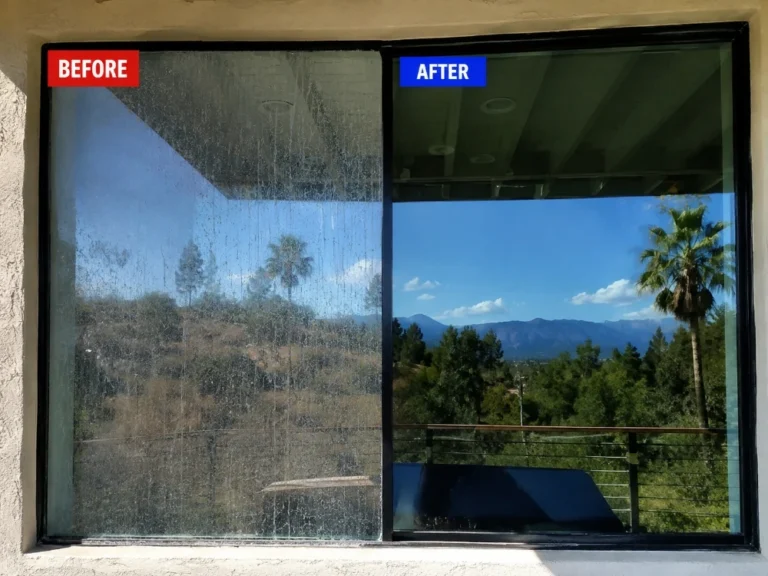
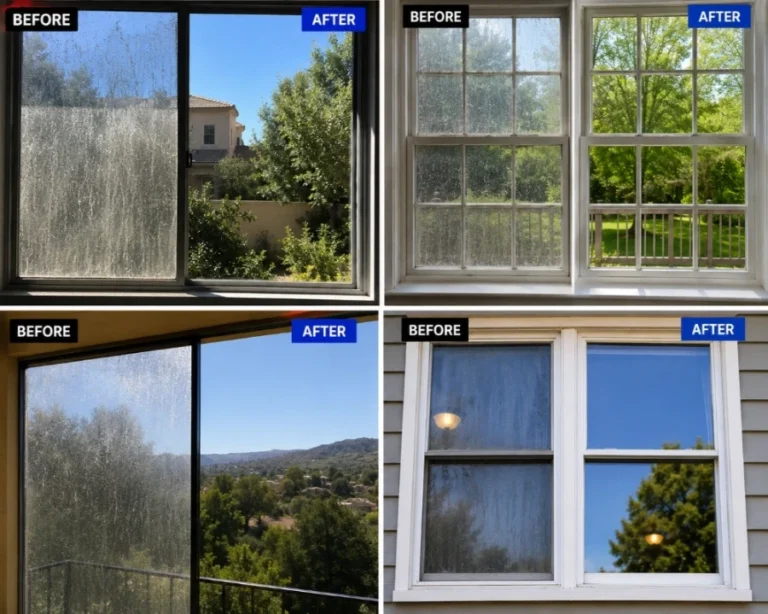
The problem is not the cleaning process — it is the drying process. When a cleaner uses tap water, the actual cleaning removes dirt, salt film, and organic matter from the glass surface. But as the water evaporates under San Clemente’s sun — which accelerates evaporation dramatically — the dissolved minerals remain on the glass. Within minutes on a warm day, a fresh calcium carbonate film has been deposited exactly where the cleaning removed the previous one.
This is why windows cleaned with tap water often look clean when wet but hazy or spotty within an hour of drying. The cleaner was effective. The water created a new contamination layer.
Can you use tap water to clean windows in San Clemente?
Technically yes, but the result will be spotted. San Clemente tap water contains 500–700 ppm of dissolved calcium, magnesium, and silica. When tap water evaporates from glass, those minerals remain as a white film — often indistinguishable from the salt film that was just removed. Professional window cleaners serving San Clemente coastal homes should use a reverse osmosis or deionization system verified at below 10 ppm TDS before cleaning begins.
How the Purification System Works
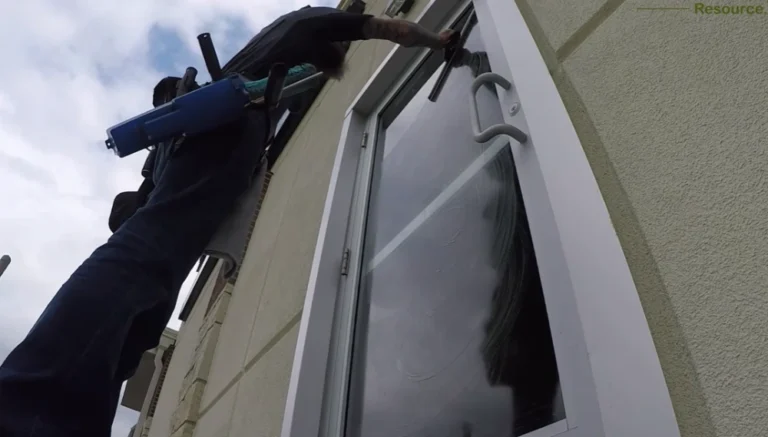
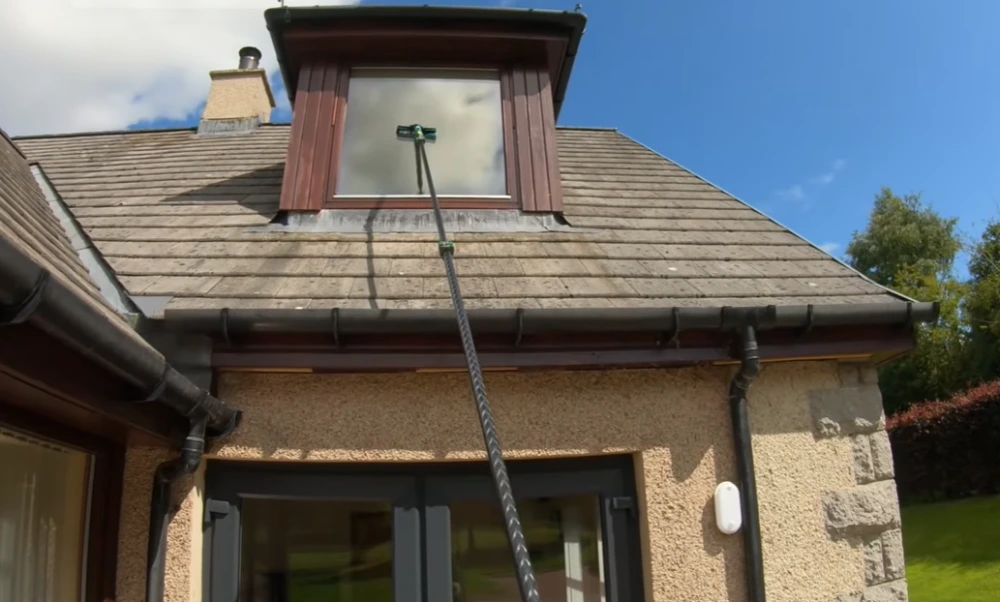
Professional water-fed pole systems used for coastal window cleaning typically use one of two purification methods or a combination of both:
- Reverse Osmosis (RO): Water is forced through a semipermeable membrane under pressure, which blocks dissolved minerals. RO systems typically reduce TDS from 600 ppm to 30–60 ppm — a significant improvement, but not zero.
- Deionization (DI): Water passes through a resin bed that exchanges mineral ions for hydrogen and hydroxyl ions (which combine to form pure water). A properly regenerated DI resin tank produces output of 0–5 ppm TDS.
- RO+DI combined: The professional standard. RO does the heavy lifting to extend DI resin life; DI polishes the output to zero. Output should be verified with a TDS meter before use.
The Coastal Chemistry Problem: Why San Clemente Needs Purer Water than Inland Cities
In an inland city like Riverside or Ontario, a window cleaner using 30–40 ppm RO water will get acceptable results because there is no competing contamination from salt aerosol. In San Clemente, the glass surface already has hygroscopic (moisture-attracting) salt residue from the Pacific. When moderately purified water hits that surface, the minerals in the cleaning water bond with the salt residue and create a compound deposit that is harder to remove than either alone.
This is the specific reason that 0-ppm TDS water — verified, not assumed — is the professional standard for coastal California window cleaning. It is not marketing. It is chemistry.
How to Verify Your Window Cleaner Is Actually Using Purified Water
Ask the cleaner to show you the TDS meter reading from their output water at the start of the job. A professional coastal cleaner should be able to produce a reading of under 10 ppm — ideally 0–5 ppm. If the reading is above 30–40 ppm, the system is either under-dimensioned for San Clemente’s input water or the DI resin needs replacement.
| TDS Level | Water Quality | Result on SC Glass |
|---|---|---|
| 0–10 ppm | Professional standard | No spots. Glass dries clear. |
| 10–30 ppm | Acceptable inland | Light spotting may appear on warm days |
| 30–100 ppm | Inadequate for coastal | Visible mineral film within 1 hour |
| 100+ ppm (tap-equivalent) | Creates new contamination | Haze identical to pre-clean condition |
We verify our water output with a TDS meter before every San Clemente job. We will show you the reading on arrival. If you have been getting spotted windows after cleaning, the water is the most likely cause. Call (949) 387-4521 — same-week scheduling available.
📞 Call (949) 387-4521San Clemente Area Guides
Window cleaning needs vary significantly across San Clemente neighbourhoods. See our area-specific guides:
How to Test Your Window Cleaner’s Water Quality
Any professional window cleaning company in San Clemente that claims to use purified water should be able to demonstrate this before starting work. The test is simple and takes under 30 seconds: a handheld TDS (Total Dissolved Solids) meter dipped into the working water tank displays the dissolved mineral content in parts per million. Genuine purified water reads 0–10 ppm. San Clemente tap water reads 500–700 ppm. If a company cannot produce a TDS meter reading on request, they are not using purified water regardless of what their marketing says.
We verify our water supply with a TDS meter on arrival at every job and show you the reading before touching any glass. This is not a performance — it is our quality control standard. We also test our purification system output before departure from our base each morning. If the purification output rises above 10 ppm (indicating a filter that needs replacement), we replace the filter before any service visits that day. You should expect any professional window cleaning company to offer this level of transparency.
What Happens to Glass When Tap Water Is Used Repeatedly
The cumulative effect of repeated tap-water cleaning on San Clemente glass is a progressive mineral build-up that eventually cannot be removed by cleaning alone. Each tap-water clean deposits a thin mineral film. Each subsequent clean partially removes the previous deposit but also adds a new layer. Over 12–24 months, the mineral layers cross-link and bond to the glass silica surface, transitioning from a cleanable deposit to a permanently bonded mineral film that requires professional acid treatment to dissolve.
This is why San Clemente homeowners who switch from a tap-water cleaner to our purified-water service often need acid treatment on their first visit — the glass needs descaling before it can be genuinely cleaned. After the first purified-water clean and any necessary acid treatment, maintenance cleaning with 0 ppm water prevents any further mineral accumulation. The glass stays cleaner for longer and never develops the secondary bonding layer that requires acid treatment.
How to Verify Your Window Cleaner Is Using Purified Water
The claim “we use purified water” is easy to make and impossible for a homeowner to verify without a TDS meter — unless the cleaner shows you the reading. A genuine purified water window cleaning operation carries a handheld TDS (Total Dissolved Solids) meter and shows you the tank water reading on arrival. The number should be 0–10 ppm. San Clemente tap water reads 500–700 ppm. A reading above 50 ppm means the purification system is not performing to standard — the water will leave mineral deposits when it dries. We verify and show you our reading on every job. If any San Clemente window cleaner cannot or will not show you a TDS reading before starting, they are not using purified water regardless of what their website says.
The economics of purified water systems explain why many companies still use tap water despite advertising otherwise. A proper RO/DI (Reverse Osmosis / Deionisation) water purification system costs $1,500–$4,000 to purchase, requires filter maintenance every 3–6 months at $80–$300 per service, and adds significant weight to the service vehicle. For a small operation prioritising low overheads, the temptation to use tap water and claim purified water is real. The homeowner pays the difference — in repeat acid treatment costs, in etching risk, and in the frustration of glass that never stays clean.
0 ppm Water and the No-Spots Guarantee
When glass is cleaned with verified 0 ppm water and squeegeed correctly, it should be completely spot-free when dry. Not mostly spot-free. Not spot-free in good light. Completely spot-free under raking light, in direct sun, and at any viewing angle. This is the standard we hold ourselves to on every San Clemente job and the basis of our no-mineral-spots guarantee. If spots appear within 48 hours of our visit on glass we cleaned, we return and re-clean at no charge. In practice this almost never happens — because 0 ppm water leaves nothing behind. The only spots that appear after a genuine purified water clean are from new salt aerosol deposit (which is expected and is why a cleaning schedule exists) or from rain runoff carrying roof debris down window glass (also expected).
Purified Water Window Cleaning — Frequently Asked Questions
How do I know if my window cleaner is actually using purified water?
Ask them to show you the TDS reading before they start. A genuine purified water system will read 0–10 ppm on a TDS meter. San Clemente tap water reads 500–700 ppm. If a company cannot produce a meter reading on request, they are not using purified water regardless of what their marketing says. We verify our water supply on arrival at every job and show you the reading before touching any glass. No reading means no proof.
Why does purified water cost more than a standard clean?
Purified water systems require significant capital investment — a professional reverse osmosis and deionisation system capable of producing 0 ppm water for a full day of service costs $3,000–$8,000. The filtration media requires regular replacement. The storage tank and delivery system adds further equipment cost. These are real costs that separate genuine purified water service from a company that bought a squeegee and a bucket. The price difference between a purified water clean and a tap water clean is typically $30–$80 per visit — less than the acid treatment bill that accumulates when tap water deposits are allowed to build.
Is purified water window cleaning safe for all types of glass?
Yes — 0 ppm water is chemically neutral and has no reaction with any type of glass including tempered, laminated, low-e coated, and historic single-pane glass. The purified water system works by removing ions from the water, not by adding chemistry. The agitation technique (soft bristle brush) is adjusted for glass type — lighter agitation on older single-pane glass, standard agitation on modern tempered glass. Purified water is safer for glass than tap water, which introduces mineral contamination with every application.
The Long-Term Economics of Purified Water Cleaning in San Clemente
Over a 5-year period, a San Clemente homeowner using purified water professional cleaning typically spends $200–$400 less in total than one using tap-water cleaning — despite a higher per-visit cost. The reason is acid treatment prevention. Tap-water cleaning deposits 500–700 ppm minerals every visit. After 12–24 months these deposits require professional acid treatment at $80–$200 per visit to dissolve. A homeowner on a quarterly tap-water cleaning schedule pays for acid treatment 1–2 times per year in addition to the base clean. A homeowner on a quarterly purified-water schedule never pays for acid treatment at all. The cumulative saving over 5 years outweighs the higher per-visit cost by a meaningful margin.